Your MAP policy is only as good as your ability to enforce it.
Every retailer that undercuts your Minimum Advertised Price trains your customers to wait for a discount, and trains your other retailers that the policy doesn't stick. PriceSentry watches every retailer selling your products and flags violations the moment they happen: no repricing, no automation risk, just visibility you can act on.
Register your interestMAP floors, not repricing rules
Set a floor per product and get alerted on breach. PriceSentry never touches your retailers' prices. This is monitoring for enforcement conversations, not automation.
Every retailer, one view
Assign every retailer page selling a given product and see violations side by side: who's compliant, who isn't, and for how long they haven't been.
GTIN matching keeps the data honest
Products are matched to retailer listings by GTIN/barcode first, so a violation report is comparing the exact same item, not a similarly-named variant that happens to be cheaper.
A paper trail for enforcement
Price history is timestamped and retained, so when a violation conversation happens, you're not relying on a screenshot someone forgot to take.
Instant or digest alerts, your call
Get notified the moment a tracked competitor's price moves, or roll every violation into a daily or weekly digest if that fits how your team actually reviews compliance.
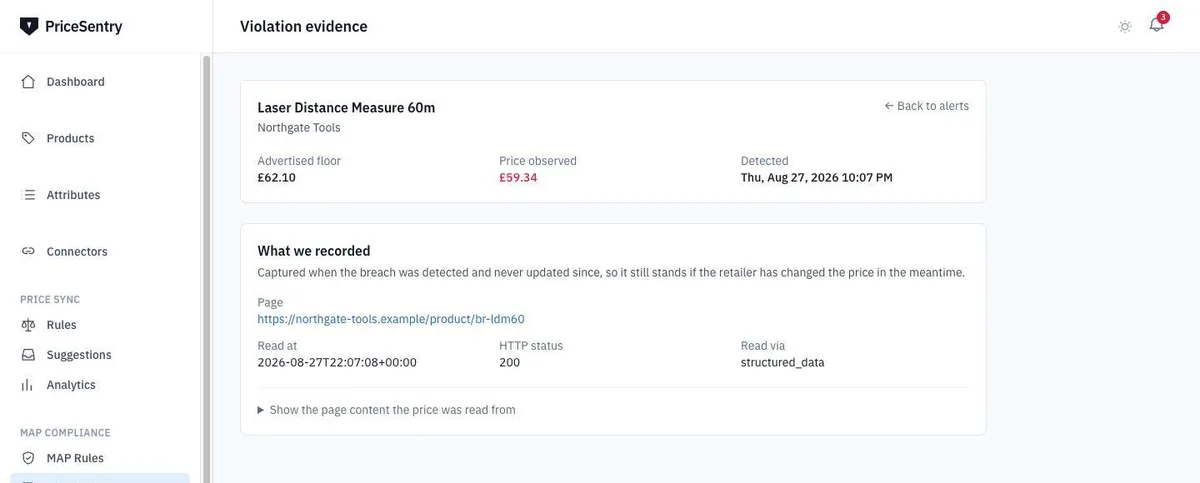
Proof you can put in front of a reseller.
Every violation records the page, the price we read, when we read it, and the raw page content it was read from — captured at the moment of the breach and never updated since, so it still stands after the price has quietly gone back up.
Frequently asked questions
Does PriceSentry enforce MAP automatically?
No, and deliberately so. MAP monitoring surfaces violations for you to act on (a call, an email, a distribution agreement clause) rather than automating any action against a retailer's price, which you don't control and shouldn't attempt to.
How many retailers can I monitor per product?
As many as you assign. Each is tracked independently with its own price history, so a report can show every retailer's compliance status for a given product side by side.
How is a violation actually detected?
You set a floor price per product (or let a matching rule apply one across a set of products). Every check below that floor is flagged. Because it's matched by GTIN, you're never comparing against the wrong variant or bundle.
Can I export the violation history?
Price history is timestamped and queryable via the API, so it can feed whatever enforcement or reporting workflow your legal or sales-ops team already runs.